Porto Wine Tours with Kids: A Family Guide
Most Port cellar tastings are built for adults. The river, the double riverfront, and a short list of tours with real stated child policies are where families should start.
Booking Choice: Start with a short six-bridges cruise for a family city outing. Taylor’s lists grape juice for under-18s; use the party and age choices below to compare published formats. Explore Porto Six Bridges Cruise
A Port tasting is a room of adults holding small glasses of wine fortified to around twenty percent alcohol while somebody explains oxidative ageing and the difference between a colheita and a 20 year tawny. That is a very good hour if you are forty. It is a long one if you are seven.
At A Glance: Keep visits short and varied, and verify the child ticket rather than assuming every wine tour welcomes every age. Food portions and child drinks differ by product. Explore Porto Six Bridges Cruise
So here is the honest framing before any of the practical advice. Most cellar tastings in Vila Nova de Gaia are an adult activity. They are not built for children, the majority publish no child policy at all, and the legal drinking age in Portugal is 18. What Porto does have, and what makes it genuinely workable as a family destination for wine-interested parents, is a river, two walkable riverfronts facing each other, and a small number of tours that state a real child policy up front. Our team went through the listings featured on this site and pulled exactly which ones do.
| Quick summary | Detail |
|---|---|
| Honest starting point | Most Gaia cellar tastings are an adult activity, not a family outing |
| Tours with a published child policy | Two: the ten-hour Douro and Vinho Verde day tour, and the four-hour Porto food and wine walking tour |
| Easiest family booking | The two-hour Douro river cruise with a Port tasting, $47, rated 4.8 |
| Hardest family booking | Any ten-hour Douro Valley day with children under about six |
| Best free family hours | The Gaia and Ribeira riverfronts, plus the upper deck of the Dom Luís I Bridge on foot |
| Legal drinking age in Portugal | 18 |
| Always confirm before booking | Child pricing, pram access, and whether minors may enter the cellar at all |
| Realistic plan | One family activity on the water, one adult tasting handled in shifts |
How long is each tour, and can your kids sit through it?
Durations are the listed tour lengths. The shaded band marks the roughly three-hour ceiling our team suggests for most children under eight, which is guidance rather than an operator rule. The two-hour river cruise is the easiest family booking in Porto; the ten-hour valley day is the hardest.
Can children go on Porto wine tours at all?
Some tours, yes, with a policy stated in writing. Most cellar tastings, no, or not in any meaningful way. The tasting itself is an adult activity, lodge rules on accompanied minors vary house by house, and the only reliable answer is the one published on the operator's own listing for the specific tour you are booking.
It helps to separate three things that get lumped together as "a wine tour". There is the cellar walk, where a guide takes you through barrel halls and explains ageing. There is the tasting, which is the part with the glasses. And on many tours there is a transport or river element, a boat leg or a drive out to the valley.
Children can often be fine with the first and the third. The second is not for them, and no amount of positive framing changes that. We are not going to tell you a barrel cellar is magical for a four-year-old. It is dark, cool, strongly scented with wood and spirit, and every word of the commentary is aimed at adults.
What varies, and what you have to check individually, is whether a given lodge admits accompanied minors to the walking portion at all. Some do, some do not, and policies change. Rather than guess, read the child policy on the listing for the exact tour you want and message the operator if it is silent. A tour that says nothing about children is not the same as a tour that welcomes them.
Which Porto wine tours actually state a child policy?
Two of the tours featured on this site publish one in their own FAQs. The ten-hour Douro and Vinho Verde day tour states it is open to ages 0 to 120 and calls itself a great family-friendly option. The four-hour Porto food and wine walking tour states that children aged 4 to 14 pay half price and under-3s go free.
Those are real published policies for those two specific tours, not a general rule across Porto wine tourism. Treat them as the exceptions they are, and do not assume a similar policy applies to a cellar tasting elsewhere just because these two exist.
| Tour | Length | Price | Rated | Stated child policy |
|---|---|---|---|---|
| Douro and Vinho Verde day tour from Porto, with farm lunch and boat ride | 10h | $189 | 4.9 | "Yes, the tour is open to ages 0-120, making it a great family-friendly option." |
| Delicious Porto food and wine walking tour with a local guide | 4h | $87 | 4.8 | "Yes! This is a child-friendly tour; kids 4-14 pay half-price and those under 3 are free." |
| Douro river boat cruise in Porto with Port wine tasting | 2h | $47 | 4.8 | No child policy published. Structurally the easiest short outing with kids, but confirm child pricing before you book. |
The half-price line on the food and wine walk is worth doing the arithmetic on, because it changes the family maths substantially. At $87 for an adult, a child aged 4 to 14 comes to about $43.50. Two adults with a six-year-old and a ten-year-old works out at roughly $261 for four hours, which for a guided food tour through Porto with a local guide is a reasonable family outing rather than an indulgence.
The ten-hour valley tour is the more interesting case. Ages 0 to 120 is an unusually open policy, and it tells you the operator has thought about families. It does not tell you a toddler will enjoy ten hours. Those are two different questions, and the section further down deals with the second one honestly.
Why is the Douro river cruise the easiest family booking in Porto?
Two hours, a boat, six bridges and a view that keeps moving. The $47 Douro river cruise asks nothing of a child except to sit somewhere and look at things, which is the lowest bar any wine-adjacent activity in Porto sets. Adults get a Port tasting aboard. Nobody has to be quiet.
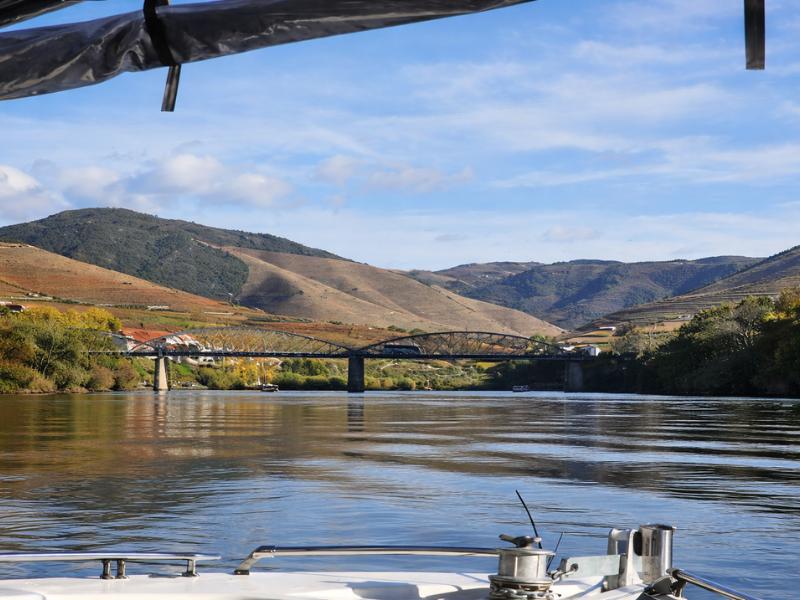
The six-bridges route is the standard Porto cruise and it earns its popularity. Boats leave from the Ribeira and Gaia quays, run downriver under the great steel arch of the Arrábida, then turn back upstream past the Luís I, the Infante Dom Henrique, the Maria Pia, the São João and the Freixo. The old rabelo hulls, the ones once used to bring barrels down from the valley, are the classic version.
For children the appeal is direct. There is water, there is engine noise, there are enormous bridges passing overhead, and the whole city rises in tiers on both banks. Two hours is short enough that even a restless six-year-old gets through it, and there is deck space to move around rather than a fixed seat for the duration.
For the adults, the tasting happens while all of that is going on, which is the quiet genius of the format. You are not asking a child to endure a wine activity. You are on a boat trip that happens to include wine for the grown-ups. Confirm child pricing when you book, since the listing does not publish a child policy.
How long a tour can your kids realistically handle?
Under threes do well up to about two hours and badly beyond it. Three to five year olds manage two to three. From six upward a four-hour walking tour becomes realistic, especially one built around food. A ten-hour valley day is a genuine ask for anyone under about ten, whatever the stated age policy says.
This table is our guidance based on how the featured tours are structured, not a rule from any operator. Your child may be the exception in either direction, and you know them better than a table does.
| Child age | Comfortable length | Works well | Better to avoid |
|---|---|---|---|
| Under 3 | Up to 2 hours | River cruise, riverfront walking, the Gaia cable car | Full-day valley trips, cellar tastings of any length |
| 3 to 5 | 2 to 3 hours | River cruise, short riverfront outings, the tram out to Foz | Ten-hour day tours, four-hour walking tours without a nap window |
| 6 to 9 | 3 to 4 hours | The food and wine walking tour at the half-price child rate, plus a cruise | The ten-hour valley day unless they are proven good travellers |
| 10 to 13 | 4 to 6 hours | Food-led walking tours, cruises, a shortened valley day if you drive yourself | Long tasting-led cellar flights where they have nothing to do |
| 14 to 17 | A full day is realistic | The Douro Valley day tour, riverfront exploring, cruises | Tastings where they cannot legally participate and will simply wait |
One pattern shows up again and again with families in Porto. The activity itself is rarely the problem. The problem is the third hour of a four-hour outing that started an hour after everyone was already tired. Front-load the day, keep the afternoon loose, and the same tour that would have collapsed at four in the afternoon goes perfectly at ten in the morning.
What is there for kids along the Porto and Gaia riverfront?
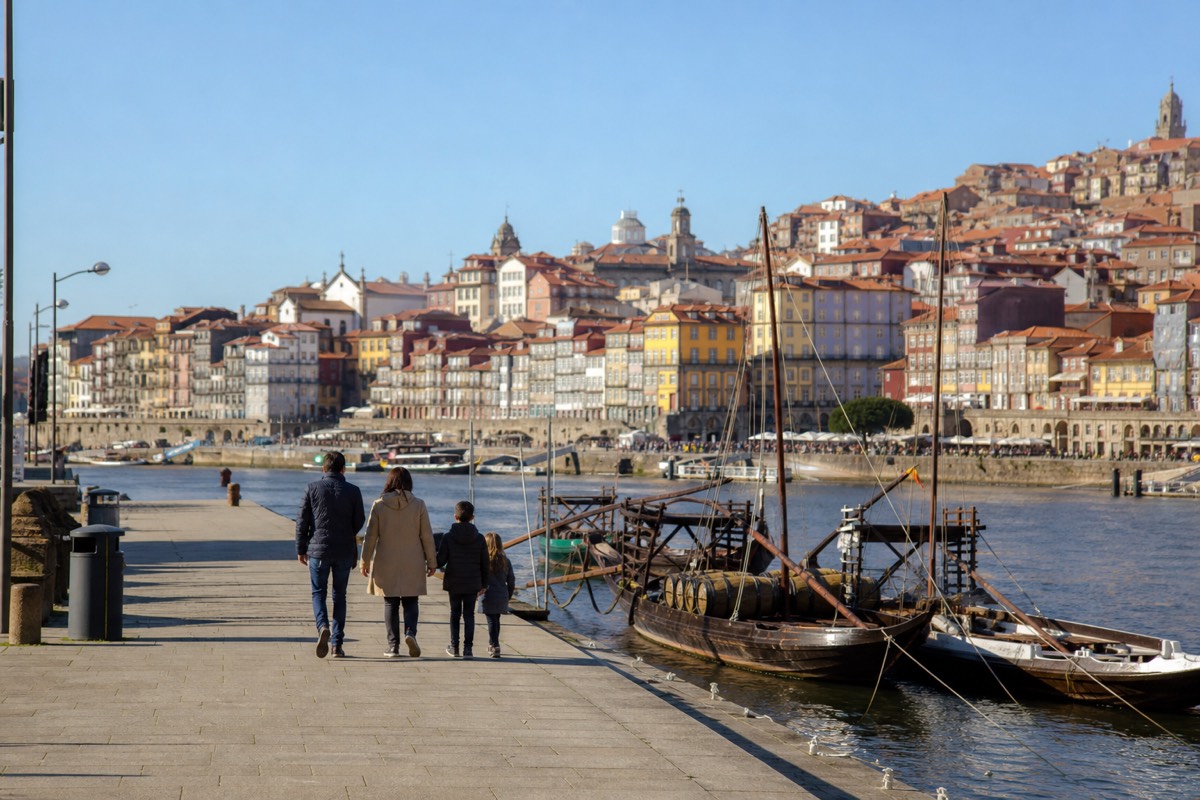
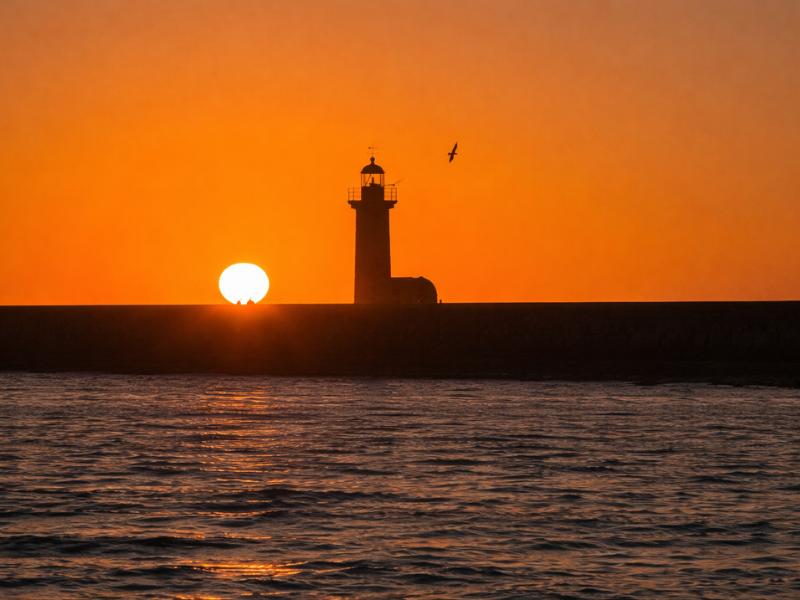
Enough to fill two full days without a single tasting. The riverfronts on both banks are flat, wide and pram-friendly, the bridge has a walkable upper deck, there is a cable car down to the Gaia quay, and a historic wooden tram runs along the water out to the sea at Foz.
This is the part of Porto that quietly makes a family wine trip possible. Everything below sits within walking distance of the Gaia lodge district, which means one parent can take a tasting while the other has a genuinely good time rather than killing an hour.
| Spot | What kids get from it | Rough time |
|---|---|---|
| Dom Luís I Bridge, upper deck | Walking high above the river with the metro running alongside. The best free thrill in the city | 20 to 30 min |
| Jardim do Morro | Grass, space to run, and the whole Porto skyline laid out in front of you | 30 to 60 min |
| Gaia cable car | A short cabin ride between the bridge and the waterfront, straight over the lodge rooftops | About 15 min |
| Gaia quay and the moored rabelo boats | Flat, wide, easy with a pram, with barrel-laden boats to inspect | Open-ended |
| Ribeira square and the Porto quay | Buskers, cafés, river traffic, and tiled houses stacked up the hill | About 45 min |
| Funicular dos Guindais | A short funicular climb up the slope from the river, and a genuine rescue for tired legs | About 10 min |
| Tram line 1 to Foz | A wooden historic tram that runs along the river out to the Atlantic | About 25 min each way |
Three practical notes. The old town is steep, so a carrier beats a pram anywhere above the riverfront. Granite cobbles get slippery in rain, which matters more with small children running ahead. And the two banks are much closer together than a map suggests: the walk from the Ribeira across the lower deck to the Gaia lodges is a short one, which is why shift-swapping between parents actually works here.
What should a family eat and drink in Porto besides Port?
Vinho Verde for the adults and pastel de nata for everyone else. Porto's food is cheap, filling and unfussy, which suits children well. The city's own dishes are the francesinha and the bifana, the market halls are easy to wander with kids, and the northern whites are light enough to drink at lunch without ending the afternoon.
Vinho Verde is the useful discovery for parents here, and it is the opposite of Port in nearly every respect. It comes from the Minho, the green country between Porto and the Spanish border, and it is low in alcohol, often faintly spritzy, served very cold and drunk young rather than aged for decades. A glass at lunch does not take the rest of your day away from you, which is exactly what a parent needs. The full-day tour featured here that pairs the Douro with Vinho Verde covers both regions across a farm lunch and a boat ride, so it is a countryside and food day rather than a tasting marathon.
On the plate, Porto's signature is the francesinha: layers of cured meat and steak under melted cheese, flooded with a beer and tomato sauce and usually buried under chips. It is enormous, and one order genuinely feeds an adult and a child between them. The bifana, a thin pork steak in a soft roll, is the cheap and fast version, and it goes down well with almost anyone under twelve. Grilled fish and rice dishes fill out most menus, and portions in a neighbourhood tasca are large by default.
Pastel de nata is the easy win. Custard tarts are sold everywhere, they cost very little, and a warm one with cinnamon has converted many a tired child back into a functioning member of the family. The Bolhão market hall and the stalls around it are good for grazing rather than a sit-down meal, which works well when everyone wants something different.
Timing is the one thing to adjust. Portuguese dinner runs late by northern European standards, with kitchens properly filling around eight. Families do far better arriving at seven, when tables are free and food comes quickly. Lunch is the larger meal for many locals anyway, so the prato do dia at a small neighbourhood place is both the cheapest and the easiest good meal you will eat all trip.
How do families handle a cellar tasting without dragging the kids through it?
Split the group, shorten the visit, or move the tasting onto the water. Those are the three tactics that hold up. One parent tastes while the other takes the riverfront and you swap the next day, or you book the food-led walking tour where children have a stated place, or you let the tasting happen on a cruise while the kids watch bridges go by.
None of these are compromises exactly. They are just the shape a wine trip takes when there are children in it, and families who plan for that up front have a far better time than families who book a cellar tour for four and hope.
| Tactic | How it works | Trade-off |
|---|---|---|
| Tandem tasting | One adult books a cellar tour while the other takes the kids to Jardim do Morro or the cable car, then you swap on another day | You each do it alone, and it costs two bookings on two days |
| Food-led rather than tasting-led | Book the four-hour walking tour that publishes a 4 to 14 half-price child rate and a free under-3 rate | Four hours of walking is still long for anyone under six |
| Tasting on the water | Adults taste aboard the two-hour cruise while the children watch the six bridges | Fewer wines, and no cellar |
| Late slot after the kids eat | Book an evening cellar visit and use whatever childcare your accommodation offers | Depends entirely on where you are staying, so arrange it before you travel |
| Skip the cellar and buy the bottles | Pick up two or three styles from a lodge shop and taste on your own terrace | You lose the guide, the cellar and the aged pours, which is most of the point |
Of these, tandem tasting is the one families report back on most warmly, and the geography of Porto is why. The parent on duty is not stuck in a hotel room. They are on a riverfront with a cable car, a bridge and a park, ten minutes from the parent who is tasting.
Is a ten-hour Douro Valley day tour a mistake with young children?
With children under about six, usually yes, even on a tour that welcomes ages 0 to 120. Ten hours means roughly three to four hours in a vehicle, winery stops arranged around adult tasting, a long seated lunch and a boat leg. Older children handle that shape well. Toddlers rarely do.
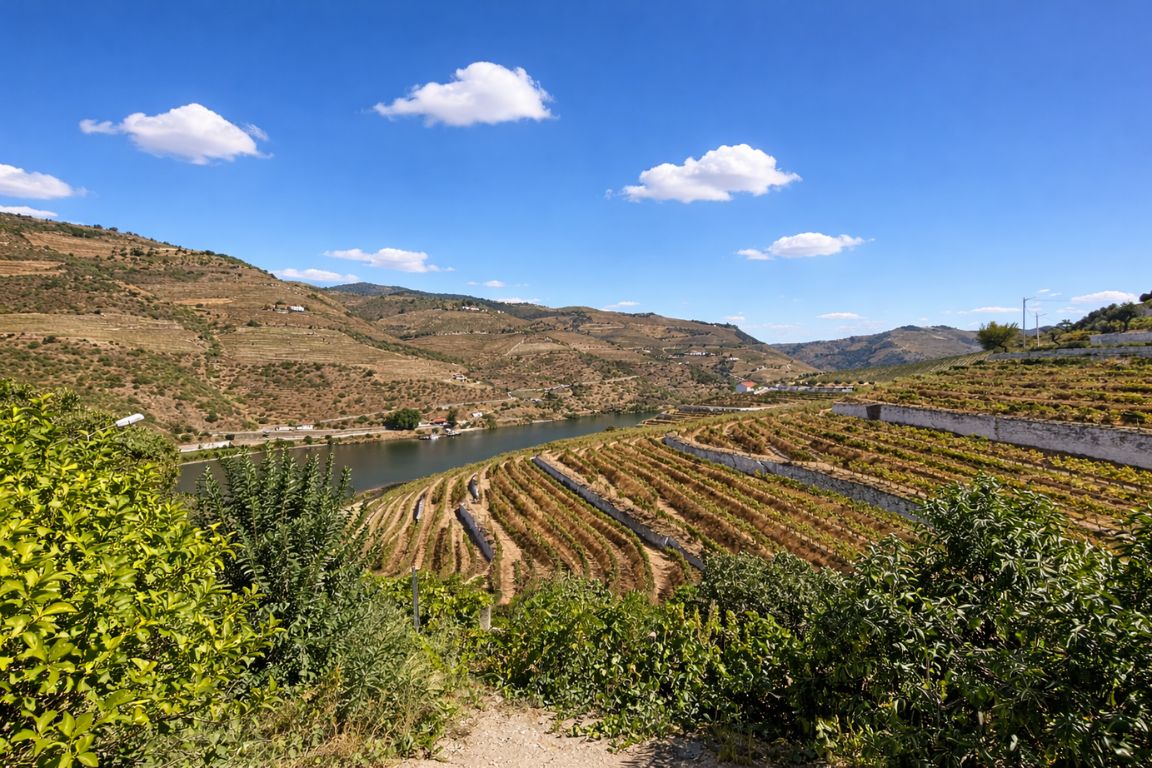
Look at what the day is actually made of. The Douro Valley starts around 100 kilometres from Porto at Peso da Régua and stretches further upriver to Pinhão at roughly 130. Even on fast motorway for most of it, that is a serious drive out and the same drive back, and the celebrated stretch of the N222 above the river is winding by design.
Between those drives you get the good part: terraced schist vineyards climbing out of the gorge, a working quinta, a seated lunch, and on the tour featured here a boat ride and a farm table. That published age policy of 0 to 120 is a real signal that the operator accommodates families, and the tour rates 4.9. For a family with children of nine, twelve and fifteen, it is one of the best days you can buy in northern Portugal at $189.
For a family with a three-year-old, the same day is four hours of car seat around activities aimed at their parents. If the valley matters to you and your children are small, the better answer is usually to give it a night rather than a day, so the driving splits in two and there is a pool or a garden at the end of it.
| Confirm before booking a valley day with kids | Why it matters |
|---|---|
| Vehicle time versus time at stops | Ten hours on the clock can be four hours in a van |
| Pickup time | Early starts and small children are a difficult pairing |
| Child restraints | Car seat rules apply in Portugal as across the EU; ask what the operator provides and whether you may bring your own |
| Lunch format | A farm table with food arriving steadily is far easier than a long tasting-paired meal |
| Length of the boat leg | A short river stretch breaks the day up beautifully for children |
| Stop frequency | Ask directly. It is a normal question and operators answer it |
| Child pricing | An open age policy is not the same as a reduced child fare; confirm both |
What does a realistic family wine day in Porto look like?
One activity on the water, one adult tasting handled in shifts, and a lot of riverfront in between. This is the plan our team would give a family with children between five and eleven, and it fits into a single day without anybody being marched through something they did not choose.
| Time | What you do | Who it is really for |
|---|---|---|
| 09:30 | Breakfast in Porto, then walk down through Ribeira to the quay | Everyone |
| 10:30 | Cross the upper deck of the Dom Luís I Bridge on foot to Jardim do Morro | Kids |
| 11:00 | Take the cable car down over the lodge rooftops to the Gaia waterfront | Kids |
| 11:30 | One adult takes a Gaia cellar tour; the other stays on the quay with the boats | Split the group |
| 13:00 | Lunch on the Gaia waterfront, facing Porto | Everyone |
| 14:30 | Two-hour six-bridges cruise with a Port tasting for the adults | Everyone |
| 16:30 | Back on the Porto bank, ice cream in Ribeira, watch the river | Kids |
| 17:30 | Rest at the hotel, or ride tram line 1 out to Foz for the Atlantic | Optional |
| 19:30 | Early dinner, children fed first | Everyone |
Run that day and the adults get a proper cellar visit each, the family gets two hours on the river together, and nobody spends an hour standing politely in a barrel hall wishing they were outside. Swap the cellar shift the following morning and both parents have done the thing they came for.
The larger point is that Porto rewards families who accept the split rather than fight it. The wine here is genuinely adult territory, and pretending otherwise leads to a bad afternoon. The river, the bridges and the two quays are for everybody, and they are the best part of the city regardless of what is in your glass.
It is worth comparing this against the other wine tour options before deciding.