History of Port Wine: The British Trade That Built an Industry
Read the names painted on the lodge roofs across the river from Porto and you are reading a list of British trading families. That is not a marketing quirk, it is the whole origin story of port.
Booking Choice: Explore the merchant and ageing story at Taylor’s in Gaia, or the vineyard side at Quinta da Foz in Pinhão. The two tickets start in different places and do not include a transfer between them. Explore Taylor's Cellar Visit
Taylor's. Graham's. Sandeman. Dow's. Croft. Cockburn's. Warre's. Those are the names on the aging warehouses lined up along the Vila Nova de Gaia waterfront, and they are English and Scottish surnames sitting in the middle of northern Portugal. Visitors notice it on the first afternoon and usually assume it is some later corporate takeover. It is the opposite. Those families were there close to the beginning, and the reason they came is a story about war, tariffs, and a river that was too dangerous to navigate but got used anyway.
At A Glance: Port’s story connects Douro vineyards, fortification and the merchant lodges in Gaia. The city cellars and the vineyard valley show different parts of that history. Explore Taylor's Cellar Visit
Port is one of the few wines whose history you can reconstruct almost entirely from trade documents rather than legend. What follows sticks to what is documented: the treaty that made Portuguese wine cheap in Britain, the minister who drew a boundary around the Douro before anyone else had drawn one anywhere, the boats that carried barrels through rapids, and the modern recognition of a landscape that people have been farming for a very long time.
Three dates that made the Douro
Not to scale: the three dates are spaced evenly for legibility, not by the years between them.
Why did the British start drinking Portuguese wine at all?
Because French wine kept becoming difficult to get. England and France spent much of the late seventeenth century at war or in trade disputes, and duties and embargoes made Bordeaux expensive and unreliable. English merchants went looking for an alternative supplier and found one in Portugal, a country their crown had been allied with for centuries.
The demand side of this story is simple. England drank a great deal of wine, most of it French, and repeated conflict with France disrupted that supply again and again. Merchants who could not source claret needed something else to sell, and the search pushed them south along the Atlantic coast to a friendly country with an alliance already centuries old.
The supply side was less obvious at the time. Northern Portugal's coastal wines were not what English buyers were after. The wines that got attention came from further inland, up the Douro River, where the valley narrows into steep rock and the summers turn brutally hot. Those inland wines were darker, stronger, and better suited to a sea voyage than anything grown near the coast. Merchants working out of Porto began buying them, shipping them from the city at the river mouth, and the wine picked up the name of the port it left from.
None of this happened as a single decision. It was decades of merchants experimenting with what survived the journey to England, gradually concentrating on the upriver valley, and building a permanent presence in Porto to manage the buying. By the time politics formalised the arrangement, the commercial groundwork was already laid.
One clarification matters here. That early wine was not port as anyone would recognise it now. It was a strong, dark Douro red, sometimes with spirit added before shipping to help it travel, and it was drunk as a table wine rather than after dinner. The sweetness, the deep sugar, the twenty-percent strength: all of that came later, out of a technical change nobody planned. The British were not asking for a dessert wine. They were asking for something drinkable that would still be drinkable when the ship docked.
| Era | What happened | What it left behind |
|---|---|---|
| Late 1600s | English merchants look past France for wine and settle on Portugal | A British merchant colony rooted in Porto |
| 1703 | A trade treaty cuts the duty on Portuguese wine entering England | A structural price advantage that lasted generations |
| Through the 1700s | Fortification with grape spirit shifts earlier into fermentation | The sweet, strong style recognised as port today |
| 1756 | The Douro is formally demarcated and regulated by the state | The first legally protected wine region in the world |
| 1800s and 1900s | Rabelo boats carry barrels downriver until roads and dams replace them | The lodge district in Gaia, and the boats on its quay |
| 2001 | The Alto Douro Wine Region is inscribed by UNESCO | International protection for the terraced landscape |
What did the 1703 trade treaty actually change?
It made Portuguese wine structurally cheaper in Britain than French wine. In exchange for English wool cloth entering Portugal on favourable terms, Portuguese wines got a reduced duty on arrival in England. That single trade-off pointed British drinking money at the Douro for decades, and the export business grew around it.
The agreement in question is the Methuen Treaty, signed in 1703 between Britain and Portugal, and it was a straightforward exchange of market access. Portugal opened its market to English textiles. Britain lowered the tariff wall in front of Portuguese wine. Neither side was thinking about the flavour of anything. They were thinking about wool, ships, and keeping a useful ally close during a period of European war.
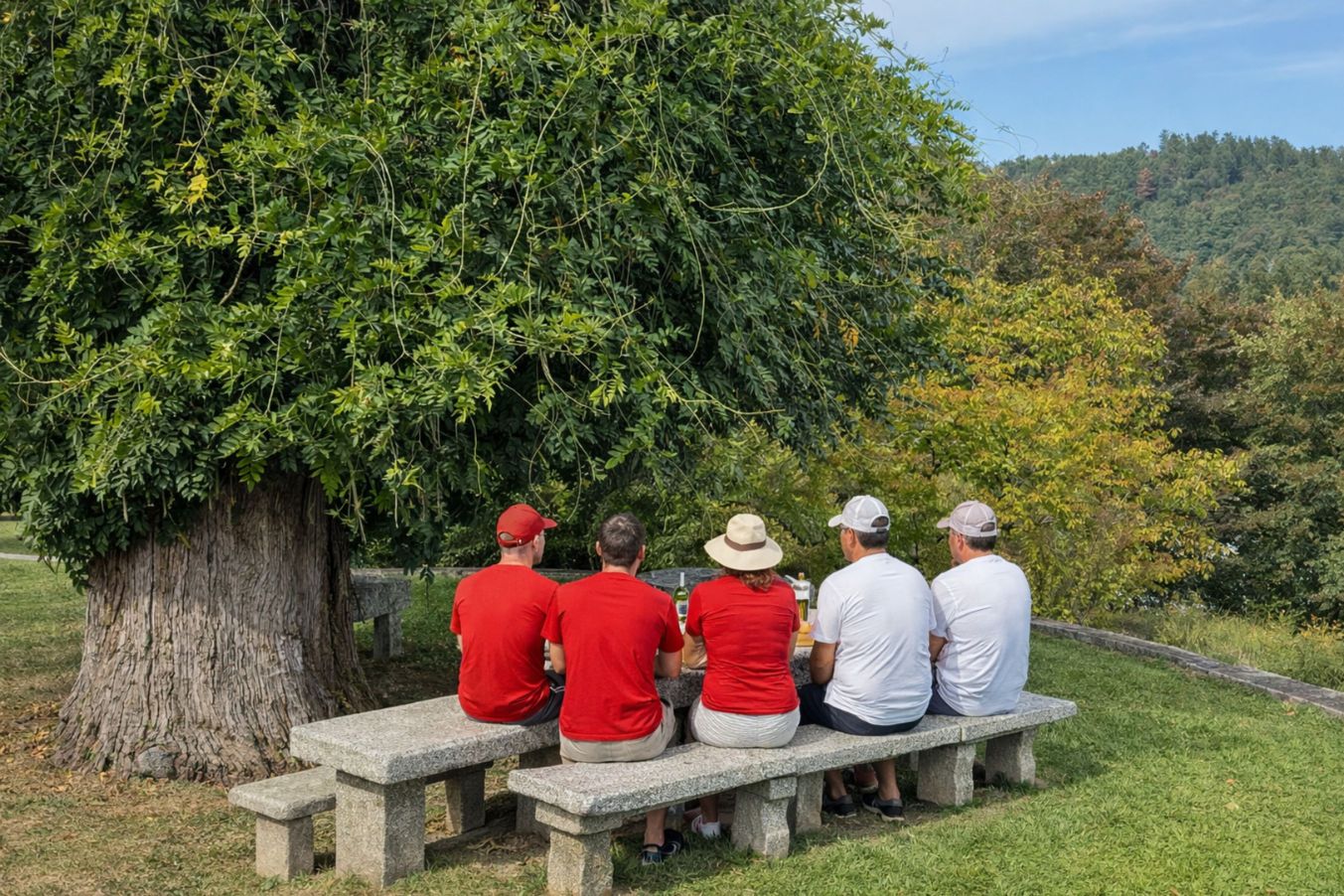
The commercial effect was enormous and long-lasting. A permanent duty advantage does not just shift a few sales, it reshapes an entire supply chain. Merchants build warehouses. Families relocate. Capital flows into vineyards hundreds of miles inland because the buyer at the far end is reliable. Over the decades that followed, the volume of wine leaving Porto for Britain climbed steeply, and the people organising that trade were overwhelmingly the British merchant houses established in the city.
That is the piece most visitors have never connected. The reason a Scottish family name ended up painted on a warehouse roof in Portugal is a tariff schedule.
| Party | What it gave | What it got |
|---|---|---|
| Portugal | Access to its market for English wool cloth | A reduced duty on its wines entering England |
| Britain | A lower tariff on Portuguese wine | A guaranteed outlet for its textile industry |
| The Douro | Nothing directly, it was not at the table | Decades of expanding demand and rising planting |
| The result | A durable price gap against French wine in Britain | An export trade run out of Porto by British houses |
Why did brandy end up in the wine?
Alcohol preserves wine, and the voyage to Britain was hard on barrels. Adding grape spirit stabilised the shipment. Historians generally agree the practice then shifted across the eighteenth century, from topping up a finished wine to adding spirit during fermentation, which is what created port's sweetness and strength.
The first purpose was practical. A barrel of ordinary table wine crossing the Bay of Biscay in a wooden ship could arrive sour. Higher alcohol content protected against that, so merchants added a measure of grape spirit before shipping. The wine that reached London was stronger than it started, and dry.
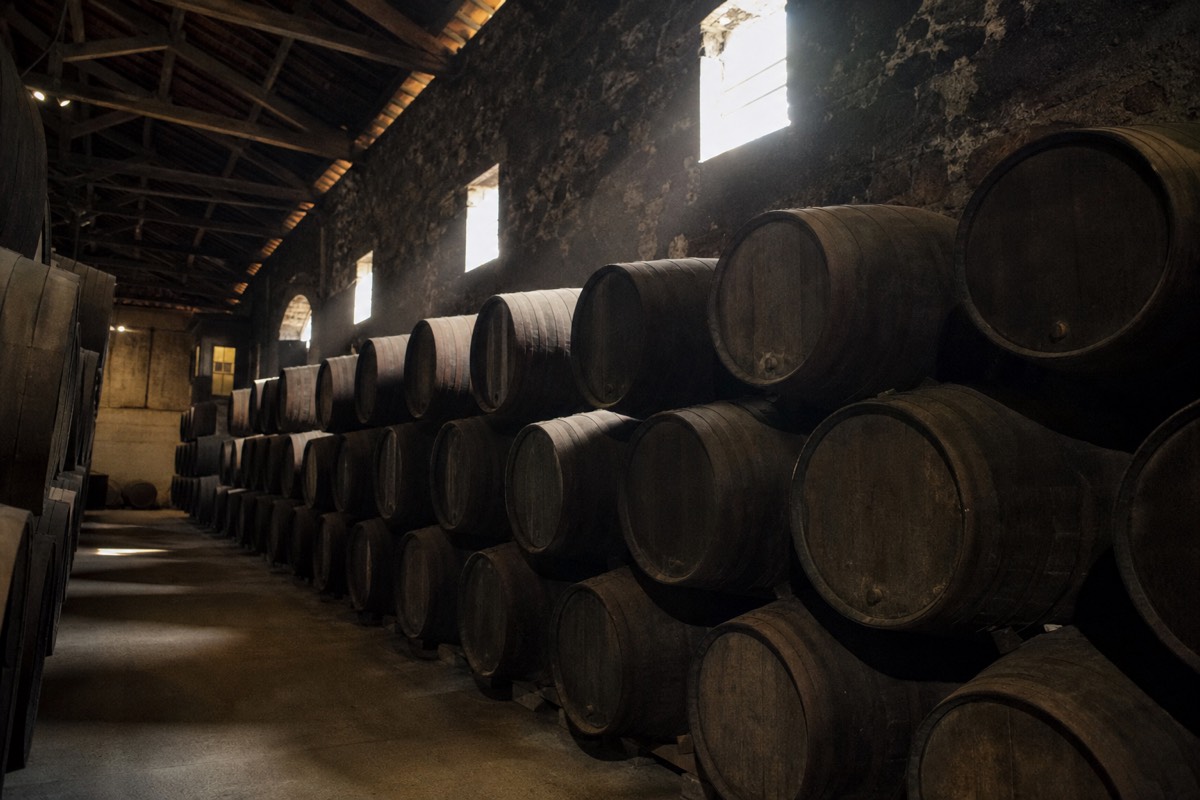
The change that mattered came later and was probably discovered rather than designed. If the spirit goes in while the yeast is still working, fermentation stops dead. The yeast dies before it can eat the rest of the grape sugar, and that unconverted sugar stays in the wine. The result is sweet as well as strong, which turned out to be exactly what the British market wanted. That is still the defining step in making port today, and it is why the category exists as something separate from Douro table wine.
The two approaches produce genuinely different drinks, and the shift between them is the moment port stopped being a fortified table wine and became its own thing.
| When the spirit went in | What you got | Where it led |
|---|---|---|
| After fermentation had finished | A dry wine, stronger than normal, stable enough to travel | The earliest shipments, closer to a fortified table wine |
| Partway through fermentation | Yeast killed early, natural grape sugar left behind, higher alcohol | The sweet, strong style the world now calls port |
Why do so many port houses carry British surnames?
Because British trading families moved to Porto to run the export business that the treaty era created. Taylor's, Graham's, Sandeman, Dow's, Croft, Cockburn's and Warre's were all founded by those merchant families. They were shippers first: buying, blending, aging and exporting, rather than farming the vines themselves.
Read the list again and the pattern in the surnames is visible. Graham, Sandeman and Cockburn read as Scottish. Taylor, Croft and Warre read as English. What they had in common was a business model rather than a homeland: a family firm with one foot in Britain and one in Porto, buying wine from Douro farmers, aging it in warehouses on the Gaia bank, and shipping it out to a market they knew intimately because they came from it.
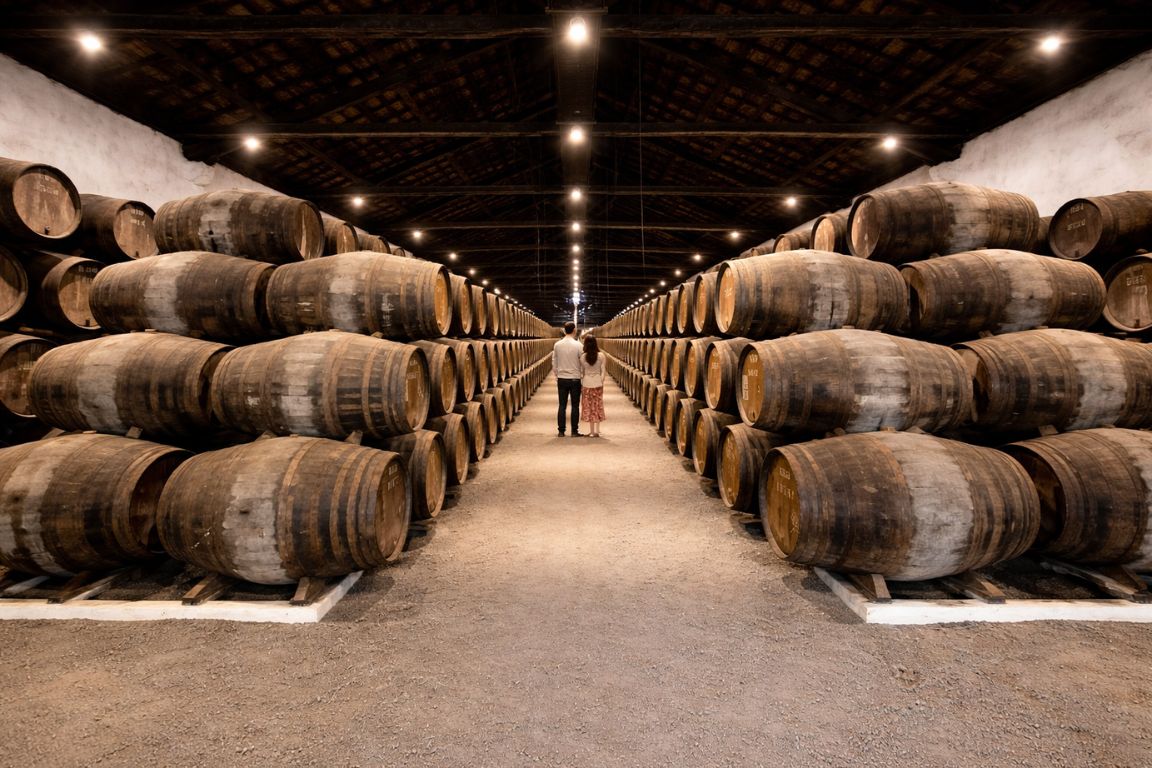
That division of labour shaped the whole industry and still does. The people who grow grapes in the valley and the houses that turn them into a branded, aged, blended product were, for a long stretch of history, different people entirely. Over time many of the shipping houses did buy their own estates upriver, which is why a modern lodge tour so often includes a story about a specific quinta. But the original structure was a merchant trade, and the vocabulary it invented is still the vocabulary used on a cellar tour today.
A British community that size builds its own world. Merchant families in Porto kept their own institutions, married among themselves, sent children back to Britain to be educated, and stayed for generations. Some of those firms are still trading under the same name centuries later, which is unusual in any industry.
The Portuguese side of the trade is the half that usually gets left out, and it should not be. The vines were planted, terraced, pruned and picked by Douro families, generation after generation, on slopes that punish everyone who works them. The wine existed before the merchants arrived. What the British houses added was capital, a distribution network, and a market with money in it, which is a real contribution and not the same thing as inventing the wine. Both halves of the story are on display today, and they sit on opposite ends of the same river.
| Term | What it means in the port trade | Where it comes from |
|---|---|---|
| Lodge | The warehouse in Gaia where barrels age | Usually traced to the Portuguese word loja, a store or warehouse |
| Shipper | The house that buys, blends, ages and exports the wine | English trade usage, and still the industry's own word for itself |
| Quinta | An estate or farm, in the Douro a vineyard property | Portuguese |
| Pipe | The traditional long cask port is aged and shipped in | English cask terminology adopted into Portuguese use |
| Rabelo | The flat-bottomed river boat that carried the barrels down | Portuguese |
| Lagar | The shallow granite tank grapes are crushed in | Portuguese |
What did the Marques de Pombal do in 1756?
He drew a legal boundary around the Douro and enforced it. In 1756 Portugal's chief minister created the Companhia Geral da Agricultura das Vinhas do Alto Douro and marked the region with 335 granite pillars. That made the Douro the world's first legally demarcated and regulated wine region, more than a century before the French appellation system.
This is the fact that ought to be on every bottle and rarely is. Long before anyone in France drew a line around Champagne or Bordeaux, a Portuguese minister put physical stone markers in the ground to define where a wine could legally come from, then set up a state-chartered company to police the trade inside that line. The pillars are known as marcos pombalinos, and 335 of them went in.
The motives were mixed, and honestly so. Part of it was quality control: the export boom had encouraged cheaper wine from outside the valley to be blended in and sold as the real thing, which was degrading the reputation of a very profitable product. Part of it was raw protectionism and state control, because the crown wanted the trade organised, taxed, and out of the exclusive grip of foreign merchant houses that had been setting the prices. Pombal was not a romantic about wine. He was a centraliser who saw an industry worth controlling.
What he built turned out to be the template. Draw a boundary, define who may use the name, grade the product, and enforce it through an institution. Every appellation system that exists today runs on that logic, and the Douro got there first.
| What 1756 introduced | Why | What it means today |
|---|---|---|
| A physical boundary, marked by 335 granite pillars | To define exactly which land counted as Douro | Only wine from the demarcated region may be called port |
| A state-chartered company for the region's wine trade | To control pricing, volume and export quality | The ancestor of the region's modern regulatory body |
| Grading of wines, with the better ones reserved for export | To protect the value of the name abroad | Vineyard and wine classification still underpins the system |
| A ban on passing off outside wine as Douro wine | Cheaper wine was being blended in and sold as genuine | The founding logic of every protected-origin system since |
How did the wine get down the river before roads and dams?
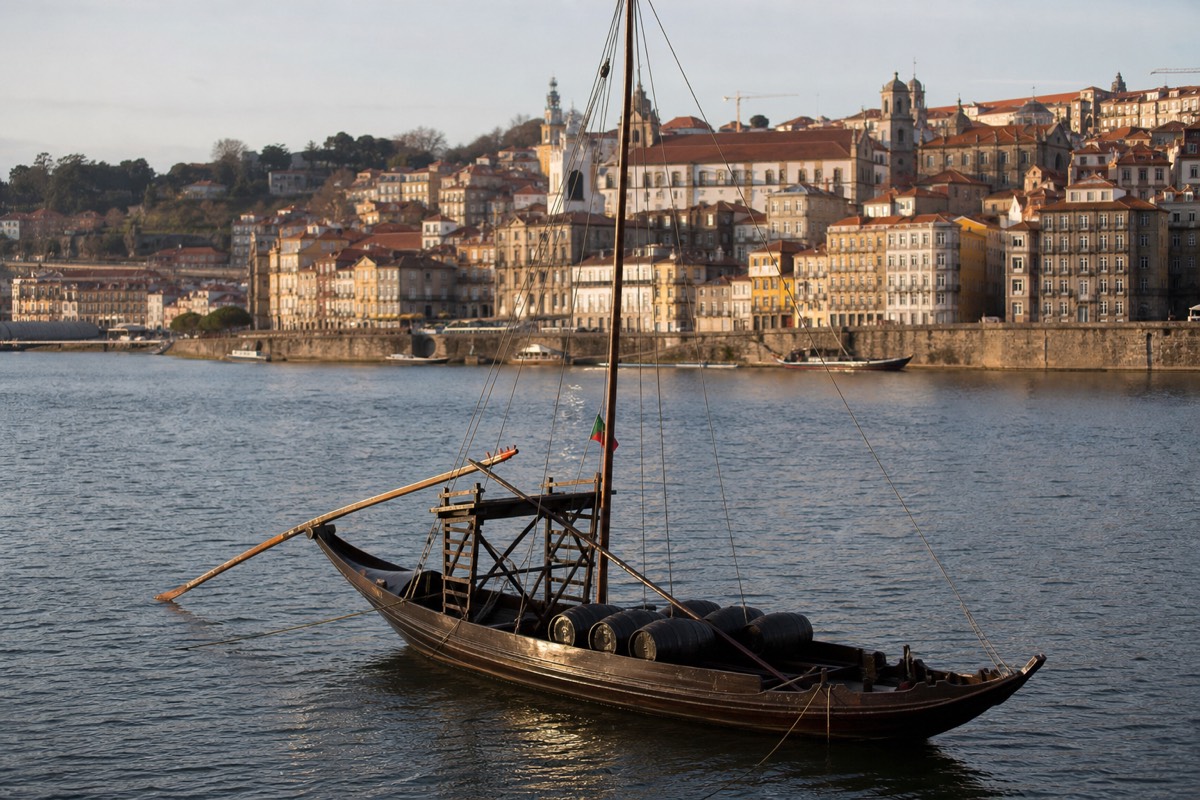
In rabelo boats. Flat-bottomed wooden craft with a single tall mast carried stacked barrels from the upriver vineyards down to the aging lodges in Vila Nova de Gaia, on a river that was fast, shallow in places and completely unregulated. Roads and later dams ended the practice.
The rabelo is the most recognisable object in the whole story and the least understood. It looks decorative now, moored on the Gaia quay with a house name on the sail, so people assume it always was. It was not. It was a cargo vessel doing a genuinely dangerous job, and the design explains the danger: a flat bottom to ride over shallows and rocks, a shallow draft for a river that dropped in summer, a single tall mast to catch what wind there was in a deep valley, and a long steering oar worked from a raised platform at the stern.
The Douro before the dams was not the calm, wide waterway that cruise boats glide along today. It ran fast, dropped steeply, and had stretches of rapids that had wrecked boats and drowned crews. Barrels of the year's production went down that river because there was no realistic alternative: the valley is steep rock, and roads capable of moving heavy cargo out of it came very late.
Two changes finished the rabelo. First proper roads, then a series of dams built along the river through the twentieth century, which flooded the rapids and turned the Douro into a chain of calm, navigable stretches with locks. By then trucks were doing the job faster and drier. The boats you see today are kept as ceremony and advertising, and the skill of handling one survives mainly in river races rather than in commerce.
| Aspect | The rabelo era | Today |
|---|---|---|
| How the wine moved | Barrels stacked on flat-bottomed boats, downriver | Road tankers and trucks out of the valley |
| The river itself | Fast, unregulated, rapids and seasonal shallows | Dammed and locked, calm enough for cruise traffic |
| The boats | Working cargo craft crewed by professionals | Mostly ceremonial, moored along the Gaia quay |
| The risk | Wrecks and lost cargo were a real business cost | None, the journey is a tourist cruise |
| Where the wine aged | The lodges on the Gaia bank, across from Porto | Gaia lodges and quinta cellars up in the valley |
How did the Douro end up on the world heritage list?
In 2001 the Alto Douro Wine Region was inscribed as a UNESCO World Heritage Site, listing number 1046. The recognition is for the landscape rather than any single building: roughly 2,000 years of continuous winemaking has physically reshaped the valley into terraced schist slopes held up by hand-built walls.
What was recognised here is unusual. Most heritage listings protect a monument, a building, a ruin. This one protects a working agricultural landscape that is still producing, still being farmed, and still changing, on the grounds that people have been growing wine in this valley for around two millennia and the evidence of that is written into the hillsides themselves.
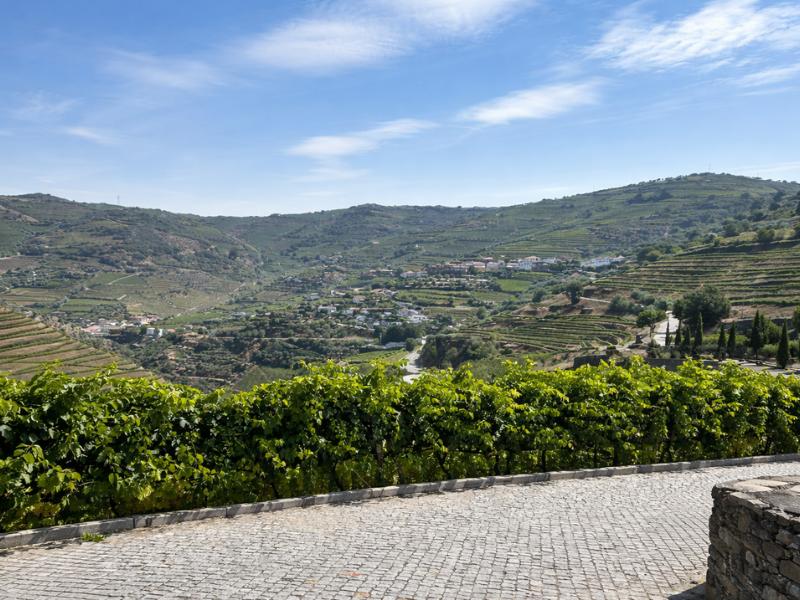
Stand anywhere above the river and you can see why. The terraces are not a natural feature. Every one of them was cut into rock and held with dry stone walls by people, and they run in stacked lines from the water up to the ridgeline across an area far too large to take in at once. That is centuries of accumulated labour, visible from a moving car, and it is the reason the valley looks the way it does rather than like ordinary farmland.
The listing also carries an obligation. A protected cultural landscape is expected to stay recognisable, which constrains what can be built, planted and bulldozed inside it. That tension between a modern wine business and a landscape that has to keep looking like itself is live in the valley today.
| Detail | What the record says |
|---|---|
| Name on the list | Alto Douro Wine Region |
| Year inscribed | 2001 |
| Official listing number | 1046 |
| Basis of the recognition | Roughly 2,000 years of continuous winemaking shaping the landscape |
| What is protected | The terraced valley itself, a living working landscape, not one monument |
What of this history can you still see and touch?
More than you would expect. The surnames are still on the lodge roofs in Gaia. Granite boundary pillars from 1756 still stand in the valley. Rabelo boats sit on the Gaia quay with barrels on deck. And the barrels themselves are still in cool stone cellars a short walk from Porto's old town.
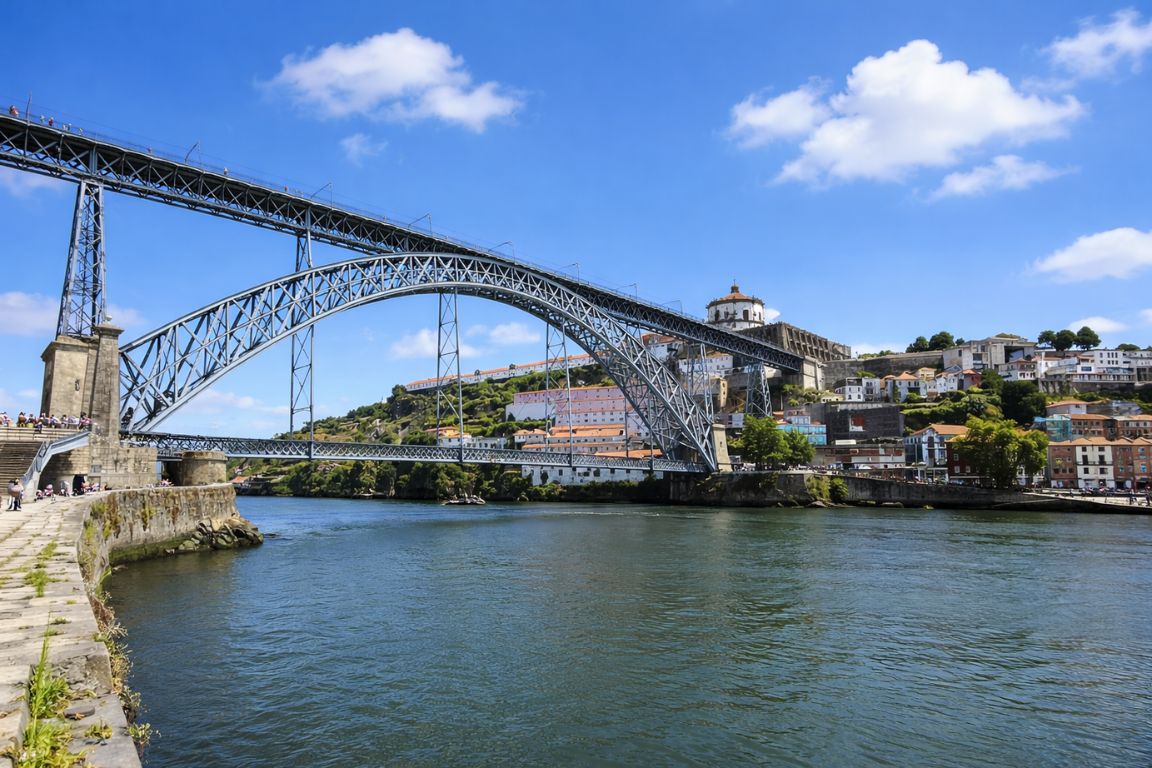
This is the part that makes the history worth reading before a trip rather than after it. The Gaia waterfront is not a museum district built to look old. It is the same stretch of bank where the barrels were unloaded, occupied by many of the same firms, doing a version of the same job. Walking it with the trade history in your head changes what the signage means.
Up in the valley the older layer survives. A number of the marcos pombalinos are still standing where they were placed, marking a boundary drawn before the United States existed. The terraces are older still in concept and constantly rebuilt in practice. A day trip upriver puts you inside the landscape that the whole export trade was built to empty.
The two halves of the story sit about ninety minutes apart. The lodges tell you what the merchants did. The valley tells you what the farmers did. Doing one without the other leaves the story lopsided, which is why plenty of visitors pair a Gaia cellar tour with a day in the Douro rather than choosing between them.
| Era | What survives | Where to look |
|---|---|---|
| The treaty and merchant era | British family names on roofs, labels and cellar doors | The Gaia waterfront, across the bridge from Porto |
| Pombal's demarcation, 1756 | Granite boundary pillars, a number still in place | The Douro Valley, upriver from the city |
| The rabelo era | Flat-bottomed boats, masts up, barrels on deck | Moored along the Gaia quay |
| Centuries of barrel aging | Rows of pipes and vats in cool, damp cellars | Inside the lodges, on a cellar tour |
| The heritage landscape | Hand-built terraces on schist slopes | The valley, seen from the river or a road above it |
A guided lodge tour in Gaia covers the merchant half of this in about three hours, with seven tastings, and the ones our team tracks run around $63 per person at a 4.9 rating from past guests. The valley half takes a full day, around ten hours door to door, typically three vineyard visits with lunch included, at roughly $133. Between them you get the entire arc: the terraces where the grapes grow, the river the barrels came down, and the cellars where the wine has been waiting.
It is worth comparing this against the other wine tour options before deciding.