Porto to Douro Valley: Train, Car, or Guided Tour
Three ways up the river, and they are not close substitutes. Here are the real journey times, the trade-offs nobody mentions until you are already committed, and an honest verdict on each.
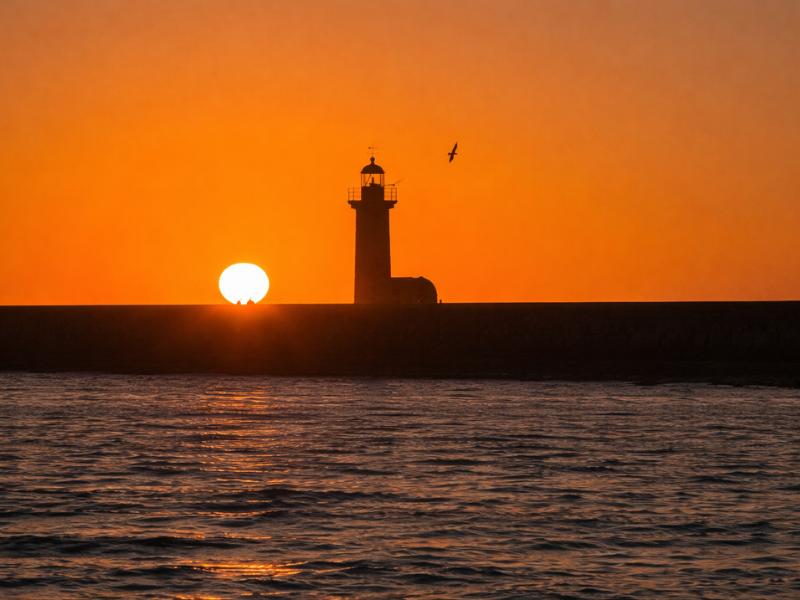
Booking Choice: A guided Douro day includes the return from Porto. For a train-based visit, Quinta da Foz starts in Pinhão; it does not include your train or a transfer. Explore Douro Wine, Lunch And River Cruise
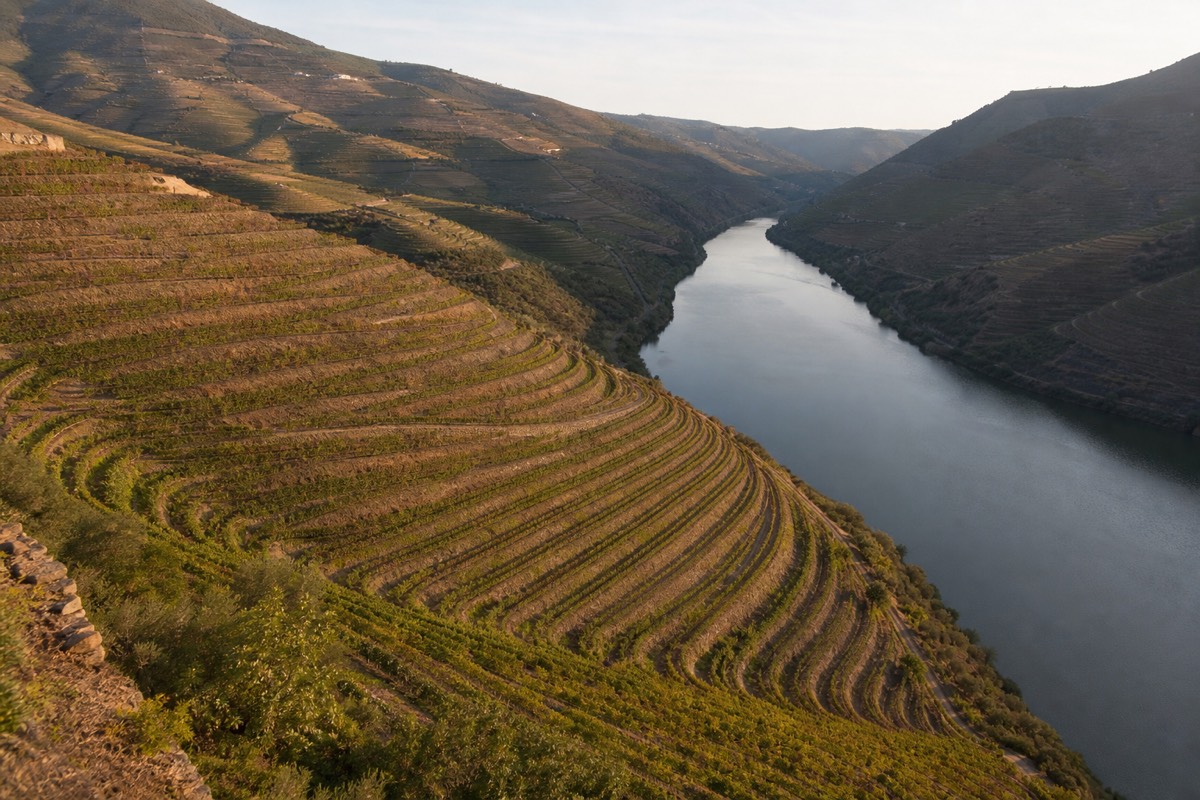
The Douro Valley is about 100 kilometres east of Porto, which sounds like nothing until you look at the terrain between them. The river has cut a gorge through granite and schist, the vineyards are stacked up the sides of it, and the roads and the railway both have to follow the water rather than cross it. Distance is not the constraint here. Shape is.
At A Glance: The train suits an independent Pinhão plan, a car needs a non-drinking driver, and a tour bundles transport with visits. Check the return timing before booking. Explore Douro Wine, Lunch And River Cruise
That is why the "how do I get there" question turns into a different question almost immediately: how do you get there in a way that still lets you drink the wine you came for. Our team runs this conversation most weeks with people planning a Douro wine trip. There are three real answers, they suit genuinely different people, and none of them is the obvious winner for everyone.
Porto to the Douro: the three routes compared
Rail figures are for the Inter-Regional service on Comboios de Portugal's Linha do Douro. Tour durations are the advertised door-to-door times on the full-day Douro departures we track.
How far is the Douro Valley from Porto, really?
Peso da Regua, the practical gateway to the valley, is roughly 100 km from Porto and about an hour and a half by car on the motorway. Pinhao is another 27 km upriver on the N222, which takes about 40 minutes. By rail, Porto Sao Bento to Pinhao is around 2 hours 20 minutes on an Inter-Regional service.
Those numbers hide the important detail, which is that "the Douro Valley" is not a single point. The demarcated region stretches more than a hundred kilometres east from just past Mesao Frio to the Spanish border, and the part most visitors mean sits between Regua and Pinhao. Getting to the edge of the region is quick. Getting to the estates in the middle of it takes longer than the map suggests.
Road and rail also take completely different lines. The A4 motorway runs inland and fast, ignoring the river almost entirely until it drops you near Regua. The railway does the opposite, hugging the water for the second half of the journey. So the fast option is the dull one and the slow option is the beautiful one, which is the whole trade-off in a sentence.
| Route | Distance | Time one way | Character |
|---|---|---|---|
| Porto to Peso da Regua by car (A4) | Around 100 km | About 1 h 30 m | Motorway, tolled, efficient and unremarkable |
| Regua to Pinhao on the N222 | 27 km | About 40 minutes | The famous stretch. Slow, winding, spectacular |
| Porto Sao Bento to Peso da Regua by train | Follows the river | Under two hours | Dull first half, riverside second half |
| Porto Sao Bento to Pinhao by train | Follows the river | About 2 h 20 m | The scenic run, roughly six departures a day |
| Guided day tour from Porto | Round trip | 9 to 10 hours door to door | Transport, estates, lunch and a boat hour bundled |
| Full-length river cruise from Porto | Upstream by water | Most of a day one way | Slow, beautiful, and a poor fit for a day trip |
One planning rule follows from all of this. Whatever mode you choose, treat the Douro as a full-day commitment from Porto, not a morning excursion. Anything that promises the valley in a half day is really selling you the near edge of it.
What is the train from Porto to the Douro actually like?
Comboios de Portugal runs the Linha do Douro from Porto's Sao Bento station east along the river to Peso da Regua, Pinhao and on to Pocinho. The Porto to Pinhao Inter-Regional takes about 2 hours 20 minutes, with roughly six trains a day. The first half is ordinary suburban track. The second half is one of the best rail rides in Europe.
Sao Bento is a good start in itself, since its entrance hall is lined with azulejo panels that are worth arriving early for. The train then spends its first hour on unremarkable track heading inland, and this is the stretch where first-timers wonder what the fuss is about. Be patient. The river appears, the line drops down to meet it, and after that it barely leaves the water.
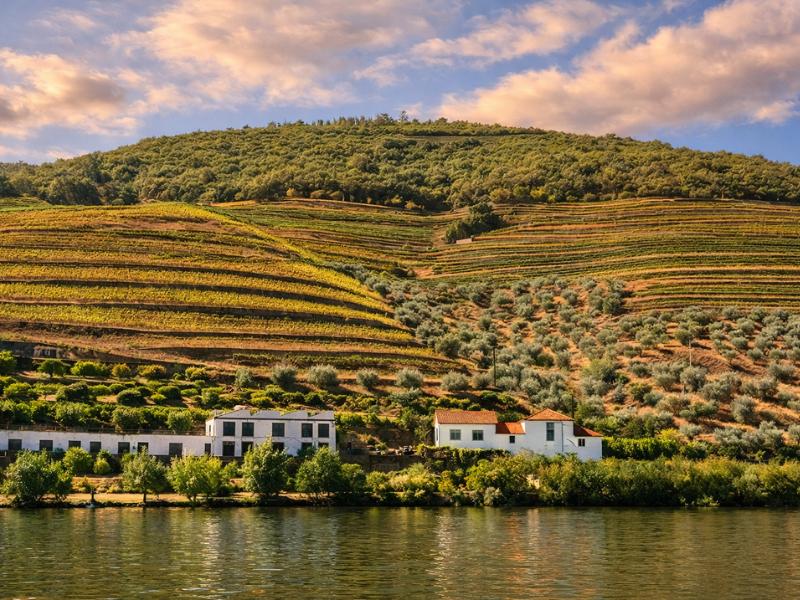
For most of the run east the river sits on the right-hand side of the train, so that is the side to aim for when you board. Seats are not usually assigned on the regional services, and the scenic stretch fills up, so getting on at Sao Bento rather than an intermediate station is a real advantage.
Pinhao's station is the reward at the end. Its platform walls carry hand-painted azulejo panels showing the Douro harvest, the picking and the boats, and they are among the most photographed tiles in the country. You step off the train straight into the subject matter of the whole trip.
| Stage of the ride | What you see | Notes |
|---|---|---|
| Porto Sao Bento | The tiled entrance hall before you board | Start here rather than Campanha for the seat choice |
| First hour out of Porto | Suburbs, then farmland and river valleys | Pleasant, not spectacular. This is the patient part |
| The river appears | The line drops to the water and stays there | The point at which everyone stops looking at their phone |
| Peso da Regua | Wider valley, the town, boats on the water | The main junction. Some services terminate here |
| Regua to Pinhao | Terraces close on both sides, tunnels, tight bends | The best 25 minutes on the line |
| Pinhao | The tiled station and the river bend | Most visitors get off here |
| Beyond Pinhao to Pocinho | The upper Douro, emptier and wilder | Fewer services. For a full day out, not a quick trip |
Two practical points. Not every departure runs the full length of the line, so some journeys mean a change at Regua; check the timetable for the specific train rather than assuming. And fares are the cheapest part of any Douro plan, typically a little over ten euros each way in second class, which makes the train the obvious choice on price and a poor one on flexibility.
Should you drive the N222 yourself?
Drive if you want to reach estates that no bus or train serves, if you are staying two nights or more, or if the road itself is the point. The N222 between Regua and Pinhao has real international press recognition as one of the world's great scenic drives. The catch is unavoidable: one person in the car cannot taste properly.
A car is the only option that opens the whole valley. Plateau villages, remote upper-Douro estates, viewpoints that no tour stops at, and the freedom to abandon the plan when you find somewhere better: none of that is available on rails or on a fixed itinerary. For a trip of three days or more based in the valley, a car is close to the default answer.
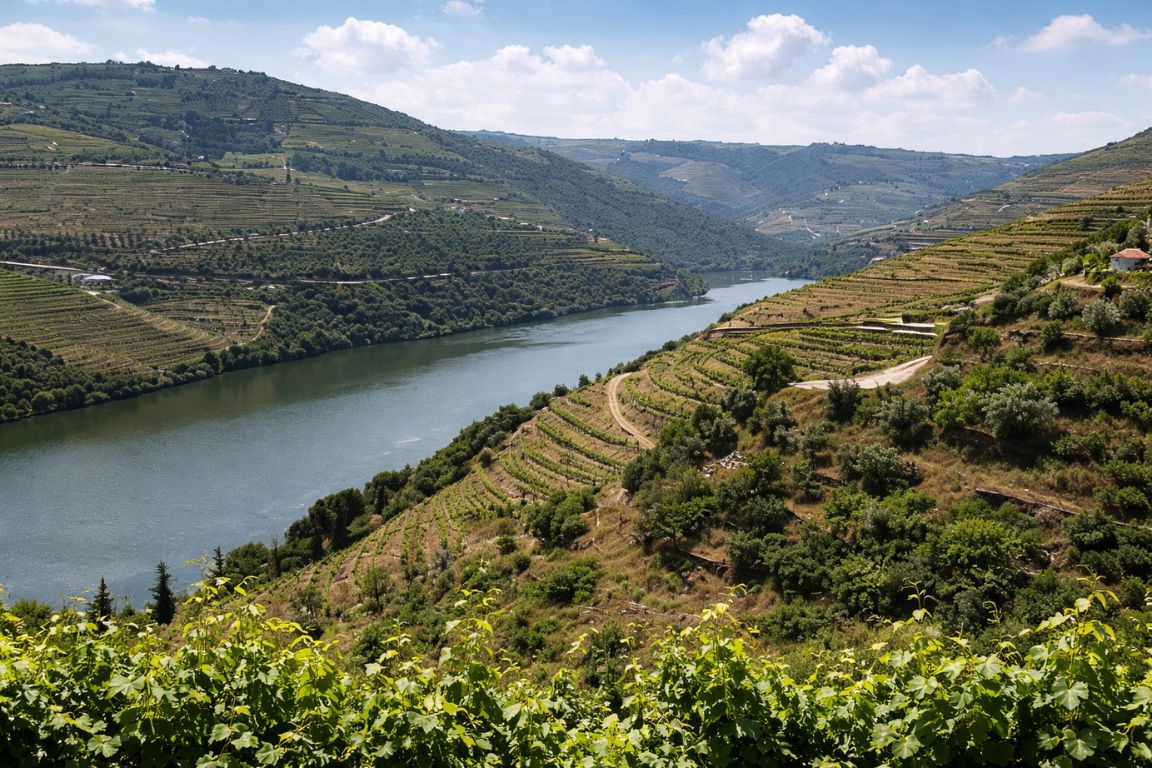
The N222 deserves its reputation. It runs along the south bank with the river below and terraces above, curling through a series of bends where the whole valley opens in front of you and then closes again. There are laybys, some of them at the good spots, and one genuine risk: everyone slows down for the view and nobody expects the car in front to stop.
Now the honest tally against. Portugal's drink-driving limit is low by international standards, at 0.5 g/L, and lower still for recently licensed drivers. A day built around five or six tastings and a lunch with wine is simply not compatible with driving, so somebody either abstains or the day gets curtailed. This is the single biggest reason guided tours dominate the Douro market.
Parking is the smaller but more frequent annoyance. Pinhao is a village with narrow lanes and limited space that fills by mid-morning in season, estate car parks can be tight, and the final approach to many quintas is a single-track lane where meeting a tractor means reversing uphill. None of this is dangerous. All of it eats time.
| Driving factor | The reality |
|---|---|
| Route | A4 motorway to Regua, then the N222 or the north-bank roads upriver |
| Tolls | The motorway is tolled electronically; confirm the rental has a transponder fitted |
| Road quality | Good surfaces, but continuous bends, blind corners and steep drops off the valley roads |
| Alcohol | 0.5 g/L limit, lower for new drivers. One person is effectively out of the tastings |
| Parking | Limited in Pinhao, tight at some estates, generally fine in Regua |
| Night driving | Unlit, narrow, and tiring after a long day. Plan to be back before dark |
| Where it wins | Multi-day stays, remote estates, plateau villages, total flexibility |
What does a guided day tour actually solve?
It solves the two problems the other options cannot: nobody has to drive, and the estates are already booked. A full-day tour bundles the round trip, two or three tastings, a sit-down lunch and usually an hour on the river into nine or ten hours, from about $108 per person. You trade flexibility for that, and for most one-day visitors it is a fair trade.
The pre-booking part is underrated. Douro estates are working farms with small visitor teams, limited tasting-room capacity and no obligation to accommodate walk-ins. Operators running the same route year-round hold standing arrangements with the quintas they visit, which matters most in exactly the weeks when booking direct is hardest, from June through the harvest season.
Then there is the driving. On a guided day, the whole party can taste at every stop, drink wine with lunch, and sleep on the way home. Compare that with a self-drive day where one person tips out every pour, and the price gap starts to look like what it actually is: the cost of not designating a driver.
What you give up is real, though, and worth naming. The schedule is fixed, the estates are chosen for you, lunch is at a set time and place, and if you fall in love with the second quinta you still leave when the van leaves. Shared departures also mean waiting for the group, which on a fifteen-seat van adds up across a day.
| Price | What that buys | Duration |
|---|---|---|
| Around $108 | Shared full day with historic sites, a winery visit, lunch and a cruise | 10 hours |
| $112 to $142 | Two vineyard tastings, winery lunch, river cruise, larger shared group | 10 hours |
| $151 to $164 | Small-group day, three tastings or a better lunch, scenic cruise | 9 to 10 hours |
| $171 to $200 | Premium wines, winery lunch, private or private-style boat | 9 to 10 hours |
| Around $249 | Fully private and customizable. Your estates, your pace, your guide | 9 hours |
Ratings across this market sit high, generally between 4.7 and 5 stars on the listings we track, which tells you the format works rather than telling you which one to pick. The real differentiators are group size, whether lunch is at an estate or a restaurant, and whether the boat hour is a scheduled cruise or a small private vessel.
Train, car, or guided tour: which one should you pick?
One day from Porto and you want tastings: take the guided tour. Two nights or more in the valley, or a strong interest in the road and the villages: hire a car. Travelling as a couple, on a budget, happy to build the day around one estate near a station: take the train. Those three cover almost everybody.
The decision hinges on one question that people rarely ask first: how many estates do you actually want to visit, and does everyone in the group want to drink at all of them? Answer that honestly and the mode picks itself. Two or more tastings for the whole party in a single day, with no overnight stay, effectively rules out driving, which leaves the train or a guided wine tour.
The train is the option most often misjudged, in both directions. People dismiss it because it "doesn't go to the wineries", which is largely true, and others overrate it because the ride is beautiful, which is also true. What makes it work is scaling the day down: one estate within reach of Pinhao station, a long lunch, an hour by the river, back on an afternoon train. That is a lovely day. It is not a wine-tasting itinerary.
Driving is the option that gets better the longer you stay. On a single Douro Valley day trip you take on all the cost and all the fatigue for one day's flexibility, and you lose a taster. Across three days based in the valley, the car pays for itself several times over in estates reached, villages seen and time not spent waiting for anyone.
| Train | Car | Guided tour | |
|---|---|---|---|
| Cost per person | Lowest by a wide margin | Rental, fuel and tolls split across the group | From about $108, all-in |
| Everyone can drink | Yes | No. One person is out | Yes |
| Estates reachable | Few, only those near a station or by transfer | All of them | Two or three, chosen by the operator |
| Scenery en route | Excellent for the second half of the ride | Excellent on the N222, less so on the motorway | Good, and someone else is watching the road |
| Flexibility | Locked to about six departures a day | Total | None once the day starts |
| Effort | Low. Sit down and read | High. Three hours of mountain driving | Lowest. You are collected and returned |
| Lunch | Whatever you find | Whatever you book | Included, usually at an estate or valley restaurant |
| Verdict | Best for couples on a budget and for the ride itself | Best for stays of two nights or more | Best for a single day out of Porto with tastings |
A hybrid deserves a mention, because it is what a fair number of experienced visitors do. Take the train up, stay a night or two in the valley, and book one guided or estate-arranged day from your base. You get the ride, you skip the rental, and you still reach estates that no timetable serves.
Can you reach the quintas once you arrive without a car?
Partly. A handful of estates are walkable from Pinhao station or a short taxi ride away, and several riverside quintas run boats between properties in season. Beyond that, most estates sit up switchback lanes with no public transport, so the answer is an estate transfer, a pre-booked taxi, or a guided day from your base.
This is the weak point of the train plan and the reason we push people to be realistic about it. Decide which quinta to visit before you book the train rather than after, because the estate you most want may be the one with no road service at all. Pinhao is a village, its taxi fleet is small, and a rank that has cars at ten in the morning may have none at four in the afternoon. Booking the return leg at the same time as the outbound is the difference between a relaxed day and a long wait.
Estate transfers are the better answer where they exist. Many quintas will collect guests from Pinhao or Regua station if asked in advance, particularly if you have booked a tasting with lunch. It is rarely advertised and frequently available, so put the question in the booking email rather than assuming.
Boats are the underused option. Scheduled services run stretches of the river in season, and around Pinhao some riverside estates move guests by water. It is slower than the road and considerably better, because the terraces make visual sense from the middle of the river in a way they never quite do from a road cut into the hillside.
What about arriving by boat from Porto?
Full-length river cruises from Porto up to Regua exist and are genuinely beautiful, but they eat most of a day in one direction, usually returning by coach or train. As a day trip they are a poor fit. The river hour that most valley tours include is a better use of the same water.
The Douro was a working waterway long before it was a scenic one. Barrels came downstream in flat-bottomed rabelo boats, riding the current from the estates to the lodges in Gaia, until a series of dams turned the river into a chain of navigable stretches. The rabelos moored on the Gaia quay today are decorative, but the route they represent is exactly the one you are travelling in reverse.
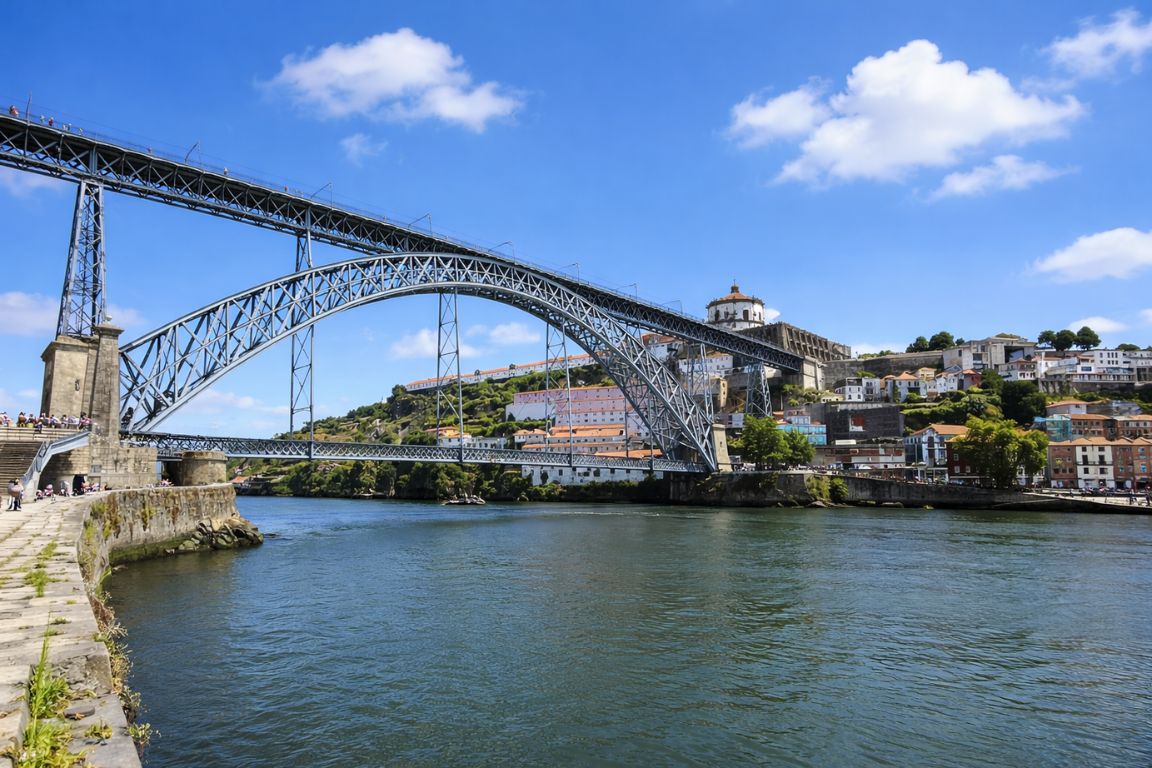
What that means practically is that going all the way upriver by boat is a full-day passage with locks, and it works best as a one-way leg on a longer trip. Most people get the water they want from the one-hour or two-hour cruise built into a valley day, or from a short Porto-based cruise under the six bridges before they ever leave the city.
What time should you leave Porto, and when will you get back?
Early. Guided full-day tours generally collect between 7:30 and 8:30 in the morning and return between 6 and 7 in the evening. If you are driving, leave Porto by eight to reach a first estate before the tour vans. On the train, aim for a morning departure and confirm the last usable service back before you commit to the day.
The last train is the trap. Services on the line are limited, the evening options thin out, and a missed connection at Regua turns into a very expensive taxi. Check the return before you book anything else, then build the day, and the rest of your wine itinerary, backwards from it.
Morning departures also buy you the better half of the day. Estates are quieter before eleven, the light on the terraces is at its best early and late, and in summer the valley heat between two and five is genuinely uncomfortable on an exposed hillside. The tour operators start early for the same reasons.
| Mode | Leave Porto | In the valley | Back in Porto |
|---|---|---|---|
| Guided full-day tour | 7:30 to 8:30 pickup | Roughly 10:00 to 16:30, all arranged | 18:00 to 19:00 |
| Self-drive day trip | By 8:00 to beat the vans | Around 9:30 to 17:00, your call | 18:30, and after dark in winter |
| Train day trip | Morning departure from Sao Bento | Roughly five or six hours around Pinhao | Evening, subject to the timetable |
| Overnight in the valley | Any time. Afternoon works well | A full day plus two evenings | Whenever you choose |
What should you sort out before you set off?
Five things, and all of them take minutes: confirm every tasting in writing with a time on it, fix your return leg before you leave, ask the estate whether it collects from the station, carry some cash, and find out what shipping a case home actually costs before you start buying. The rest of the day looks after itself.
Written confirmations matter more here than at a city attraction. A quinta may have one guide on duty and a tasting room that seats twelve, so an email with a name, a date and a time is the difference between a warm welcome and an apologetic shrug at the gate. Phone numbers are useful too, because reception in parts of the valley is patchy and a missed turning is easier to fix by voice.
Cash still has a place. Larger estates and visitor centres take cards without any trouble, but a village restaurant, a small producer selling a few bottles from the door, or a taxi in Pinhao may not, or may have a minimum. Twenty or thirty euros in notes removes an entire category of small problems.
Then there is the wine you are going to buy, because you will. Estate shops carry single-quinta bottlings and aged tawnies that are hard to find outside the region, and most quintas ship, though rates, minimum quantities and delivery times vary a lot between them. Ask at the first estate rather than the last, so you know whether to carry bottles or leave them to arrive.
| Before you leave Porto | What to do | Why it matters here |
|---|---|---|
| Return leg | Screenshot the timetable or note the tour's drop-off time | Evening rail services on the line are limited and thin out early |
| Estate bookings | Get every tasting confirmed in writing with a time slot | Working farms with small visitor teams do not absorb walk-ins |
| Onward transfer | Ask the quinta if it collects guests from Regua or Pinhao | Frequently available, almost never advertised |
| Taxis | Book both directions, not just the outbound | Village fleets are small and disappear in the late afternoon |
| Payment | Carry twenty or thirty euros in cash | Small producers, village restaurants and taxis are not all card-first |
| Shipping | Ask about rates and minimums at the first estate | Decides whether you carry bottles or have them sent |
| Winding roads | Sit forward and bring something if you are prone to motion sickness | The N222 bends continuously for 27 km |
| Clothing | Hat, water and closed shoes for vineyard walks | Terraces are exposed, steep and loose underfoot |
What goes wrong on each option, and how do you avoid it?
The train catches people out on the last service and on estate access. Driving catches people out on the drinking limit and on parking. Guided tours catch people out on pickup logistics and on group size. All three failure modes are known in advance, which means all three are avoidable at the booking stage.
Take the rail problems first, because they are the sharpest. Someone arrives at Pinhao with no plan for the last four kilometres to the estate, no taxi booked, and a return train they have not looked up. The fix costs five minutes: confirm the estate transfer, book the taxi both ways, and screenshot the timetable before you leave the hotel.
The driving problems are more predictable and more often ignored. A group hires a car, everyone tastes at the first estate, and the day quietly becomes a negotiation about who is least over the line. Decide the driver before you book, tell the estates so they can offer that person something else, or skip the car and take a guided day instead.
Tour problems tend to be about expectations rather than execution. Pickup points are sometimes a central meeting spot rather than your hotel door, group sizes vary a lot between the cheapest and the mid-range departures, and lunch is a set menu on most shared tours. All of that is stated on the listing you book through. Read the inclusions properly and there are very few surprises left.
The one that catches everybody, whatever they choose: underestimating the day. This is a ten-hour round trip into a river gorge with a lot of wine in it, and the people who enjoy it most are the ones who cleared the evening afterwards rather than booking a dinner reservation for eight o'clock.